
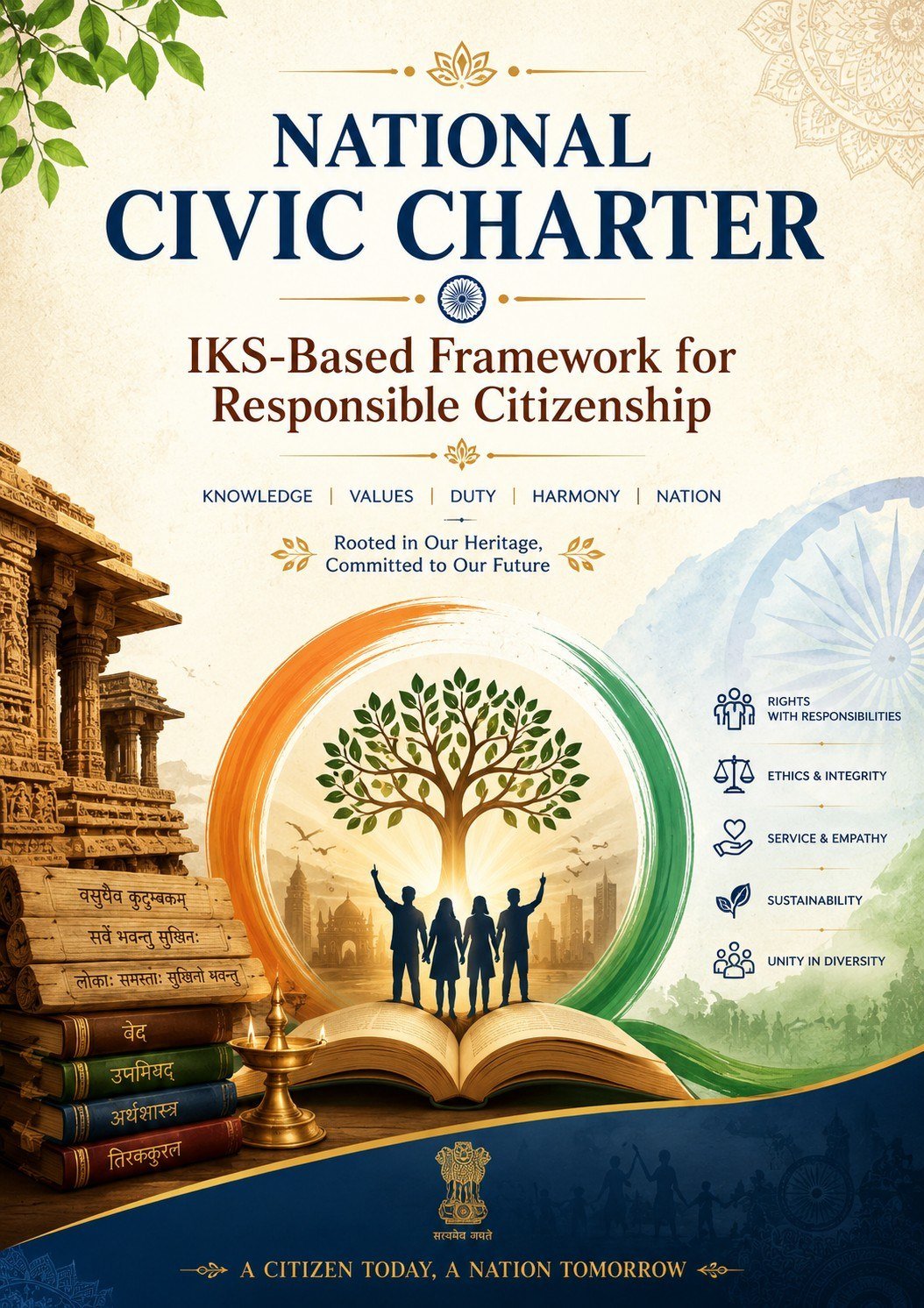
National Civic Charter: IKS-Based Framework for Responsible Citizenship
₹699.00
A structured framework for translating constitutional values and Indian civilisational ideas of duty into responsible conduct. The book presents a National Civic Charter for schools, colleges, families, communities, and public institutions, supported by behavioural indicators and an implementation roadmap.
Full Title: National Civic Charter: IKS-Based Framework for Responsible Citizenship: An Indian Knowledge System-Based Framework for Civic Duty, Constitutional Values, Community Participation, Public Institutions, and Responsible Citizenship
Author: Dr. Harshvardhan Singh
Series: Indian Knowledge System, Citizenship and Civic Character Series, Volume 3
Publisher: Educators Plus
Imprint: Elite Research Press
Publication Date: 19 February 2026
ISBN: 978-81-686513-9-5
DOI: 10.67522/iksccc.03
Pages: 196
Language: English
Edition: First Edition
Format: Downloadable Digital E-Book
Rights: All Rights Reserved
Digital Product Notice: This is a downloadable electronic publication. No physical copy will be shipped.
Important Notice: This publication is intended for academic, civic-educational, and policy discussion. It is not an official national charter, government notification, legal instrument, or administrative directive.
Description
National Civic Charter presents a structured Indian Knowledge System-based framework for responsible citizenship across educational, community, and public settings. It identifies the need for a common civic charter capable of translating constitutional values and civilisational ideas of duty into observable conduct, institutional expectations, and participatory practices.
The book studies Indian foundations of civic duty and Fundamental Duties as civic principles for contemporary India. It then develops separate but connected charter components for schools and colleges, families and communities, and public institutions. Behavioural indicators make the framework suitable for orientation, reflection, institutional planning, and civic-education programmes. The concluding roadmap addresses implementation, stakeholder responsibility, monitoring, and adaptation across diverse contexts.
The book is intended as an academic, educational, and policy-discussion resource. It should not be treated as official government policy, legal advice, administrative instruction, clinical guidance, or a substitute for authoritative statutory and institutional documents. Readers should consult current official sources wherever formal interpretation or implementation is required.
Reviews
There are no reviews yet.