
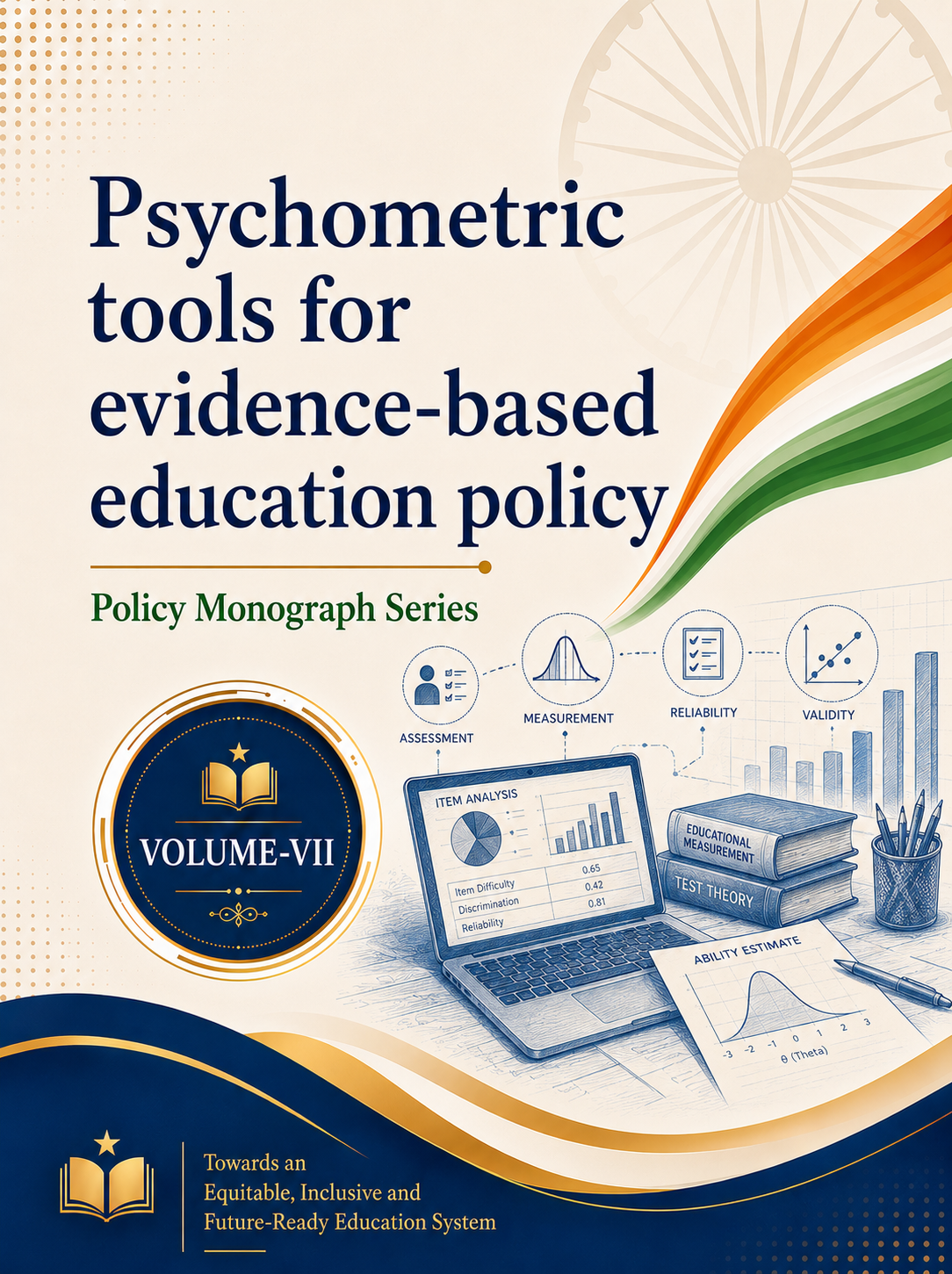
Psychometric Tools for Evidence-Based Education Policy
₹699.00
A specialised policy monograph for developing valid, reliable, ethical and action-oriented educational evidence. The book introduces the Evidence-Based Psychometric Measurement and Evaluation Framework—E-PME Framework, covering scale development, learning assessment, student support, programme evaluation, dashboards and responsible data use.
Author: Dr. Harshvardhan Singh
Series: Education for Viksit Bharat 2047: Policy Monograph Series, Volume 7
Publisher: Scholars Choice Press, an imprint of Educators Plus
Publication Year: 2026
ISBN: 978-81-686513-6-4
DOI: https://doi.org/10.67522/evb2047.07
Pages: 139
Language: English
Format: Digital E-Book
Edition: First Edition
Digital Product Notice: This is a downloadable electronic publication. No physical copy will be shipped.
Description
This policy monograph presents a comprehensive framework for using psychometric tools and educational measurement systems to support evidence-based education policy in India. It argues that education systems cannot rely only on administrative data such as enrolment, infrastructure, attendance, expenditure, programme coverage, and examination results. These indicators are necessary, but they do not fully show whether students are learning meaningfully, whether teachers need targeted professional support, whether schools are inclusive and emotionally safe, whether student support systems are functioning, or whether educational interventions are producing measurable outcomes.
The monograph introduces the Evidence-Based Psychometric Measurement and Evaluation Framework, or E-PME Framework, as an original policy model for strengthening educational measurement and data-based reform. The framework is organised around eight pillars: learning outcome and competency assessment; psychometric scale development and validation; student support, wellbeing, and readiness indicators; teacher capacity, digital readiness, and pedagogical effectiveness measurement; inclusive education and learning support measurement; programme evaluation through baseline, midline, endline, and impact indicators; data dashboards, interpretation, and policy decision-making; and ethics, equity, transparency, and responsible use of assessment data.
The book is based on a policy-synthesis and framework-development approach. It draws upon major Indian education data systems, assessment reform directions, and policy frameworks, including NEP 2020, PARAKH, NAS, UDISE+, PGI, Samagra Shiksha, FLN reforms, competency-based assessment, holistic progress cards, teacher development, digital readiness frameworks, inclusive education indicators, and programme monitoring systems. It also reflects established principles of validity, reliability, fairness, interpretation, ethical use, and responsible measurement.
The monograph is intended for policymakers, State Education Departments, SCERTs, DIETs, BRCs, CRCs, assessment bodies, universities, teacher education institutions, NGOs, school leaders, programme evaluators, and education researchers. It provides practical guidance on construct mapping, item writing, expert validation, pilot testing, item analysis, reliability and validity evidence, diagnostic assessment, student support indicators, teacher capacity measurement, inclusion measurement, programme evaluation, dashboard planning, and ethical use of assessment data.
Related products
-

Planning 21st-Century Schooling Requirements in India
₹699.00 Add to cart -

Reimagining State Public Universities in India
₹699.00 Add to cart -
Inclusive and Neurodiversity-Sensitive Education in Indian Schools
₹699.00 Add to cart -

Advancing grade-level competency and learning outcomes in Indian schools
₹699.00 Add to cart
Reviews
There are no reviews yet.