
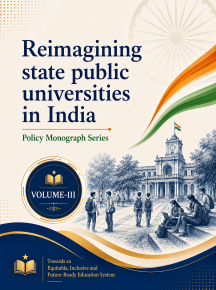
Reimagining State Public Universities in India
₹699.00
A strategic policy monograph for transforming India’s State Public Universities into quality-driven, research-oriented, digitally enabled and employment-linked institutions. The book presents the State Public University Quality Transformation Framework—SPU-QT Framework, supported by institutional diagnostic tools and reform-planning templates.
Author: Dr. Harshvardhan Singh
Series: Education for Viksit Bharat 2047: Policy Monograph Series, Volume 3
Publisher: Scholars Choice Press, an imprint of Educators Plus
Publication Year: 2026
ISBN: 978-81-686513-2-6
DOI: https://doi.org/10.67522/evb2047.03
Pages: 139
Language: English
Format: Digital E-Book
Edition: First Edition
Digital Product Notice: This is a downloadable electronic publication. No physical copy will be shipped.
Description
This policy monograph examines the strategic role of State Public Universities in India’s higher education transformation and proposes a practical framework for their reform. It argues that State Public Universities are not peripheral institutions, but central public higher education institutions that influence access, equity, affordability, employability, research culture, teacher preparation, regional development, and social mobility across India.
The monograph identifies major challenges facing State Public Universities, including governance rigidity, affiliation burden, limited autonomy, financial constraints, faculty vacancies, weak research ecosystems, employability gaps, fragmented digital systems, uneven quality assurance, and limited international visibility. It argues that these challenges are interconnected and require an integrated policy framework rather than fragmented reform measures.
The central contribution of the monograph is the State Public University Quality Transformation Framework, or SPU-QT Framework. The framework is organised around eight pillars: access, equity and regional inclusion; governance, autonomy and accountability; financing and resource mobilisation; faculty recruitment, capacity and academic leadership; research, innovation and entrepreneurship; curriculum, employability, skills and industry linkages; digital transformation and data-based governance; and quality assurance, internationalisation and institutional reputation.
The monograph is based on policy synthesis and framework development. It draws upon official higher education policy documents, public data systems, accreditation and ranking frameworks, regulatory references, and institutional reports, including NEP 2020, UGC-related policy directions, AISHE, NAAC, NIRF, NITI Aayog, PM-USHA/RUSA-related materials, and state-level higher education reform priorities. It does not present new primary survey data or independent institutional audits, but develops a reform-oriented policy framework that can be adapted by State Higher Education Departments, State Higher Education Councils, universities, affiliated colleges, IQACs, policymakers, and researchers.
Positioned within the broader national vision of Viksit Bharat 2047, the monograph argues that State Public Universities must become regional knowledge institutions, student-success platforms, research and innovation centres, teacher preparation hubs, local employment catalysts, digital governance institutions, and accountable public universities. Strengthening them is presented not only as an institutional reform priority but as a national development requirement.
Reviews
There are no reviews yet.