
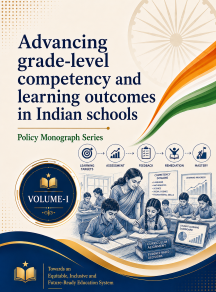
Advancing grade-level competency and learning outcomes in Indian schools
₹699.00
A practical policy monograph for transforming Indian school education from access-based schooling to learning assurance. The book introduces the Grade-Level Competency Learning Improvement Framework—GLC-LIF Model—and provides actionable tools for assessment, learning recovery, teacher support, inclusion, foundational learning, and evidence-based monitoring.
Author: Dr. Harshvardhan Singh
Series: Education for Viksit Bharat 2047: Policy Monograph Series, Volume 1
Publisher: Scholars Choice Press, an imprint of Educators Plus
Publication Year: 2026
ISBN: 978-81-686513-0-2
DOI: https://doi.org/10.67522/evb2047.01
Pages: 117
Language: English
Format: Digital E-Book
Edition: First Edition
Digital Product Notice: This is a downloadable electronic publication. No physical copy will be shipped.
Description
Advancing Grade-Level Competency and Learning Outcomes in Indian Schools: A State-Level Policy Framework for Quality, Equity, Assessment, and Learning Recovery is a policy monograph that addresses one of the central challenges of contemporary Indian school education: the shift from access-based schooling to learning-assurance-based schooling. While India has made significant progress in expanding enrolment, infrastructure, and schooling access, the monograph argues that the next stage of educational reform must focus on whether every child is actually acquiring meaningful grade-level competencies.
The monograph examines grade-level competency as a multidimensional construct involving literacy, numeracy, reasoning, communication, conceptual understanding, problem-solving, classroom participation, and socio-emotional readiness. It highlights the importance of foundational literacy and numeracy, school readiness, inclusive education, socio-emotional learning, teacher capacity, diagnostic assessment, remedial support, and data-based monitoring in improving learning outcomes.
A key contribution of the monograph is the proposed Grade-Level Competency Learning Improvement Framework, or GLC-LIF Model, designed as a state-level policy architecture for learning improvement. The framework integrates eight interrelated components: access and readiness, teacher capacity, classroom pedagogy, learning assessment, remedial support, inclusion and socio-emotional learning, data-based monitoring, and community/governance support. It is intended to help state education departments, SCERTs, DIETs, BRCs, CRCs, school leaders, teachers, NGOs, and educational researchers move from fragmented programme implementation to coherent learning assurance.
The monograph is conceptual, analytical, and policy-oriented. It draws upon national policy frameworks, public education data systems, curriculum documents, assessment frameworks, and institutional resources such as NEP 2020, NIPUN Bharat, NCF-SE 2023, UDISE+, NAS, PGI, Samagra Shiksha, PARAKH, NCERT, and related official sources. It offers implementation roadmaps, monitoring indicators, risk mitigation strategies, school improvement formats, teacher reflection tools, inclusive classroom checklists, and FLN–SEL integration matrices.
Positioned within the broader vision of Education for Viksit Bharat 2047, the monograph argues that national development requires an education system in which every child is enrolled, every child is learning, every child is supported, and every child progresses toward meaningful grade-level competency.


Reviews
There are no reviews yet.