
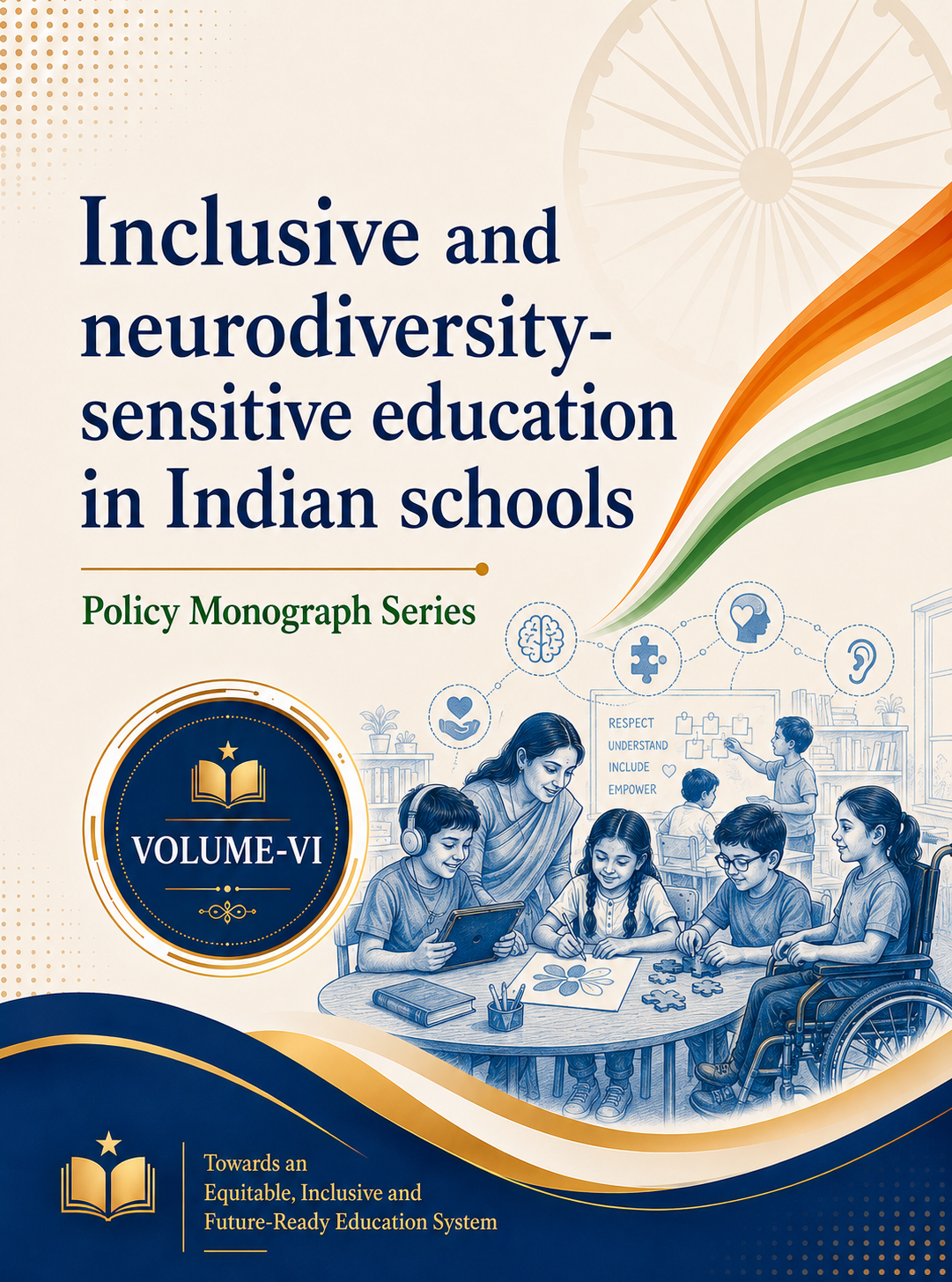
Inclusive and Neurodiversity-Sensitive Education in Indian Schools
₹699.00
A practical policy and school-implementation guide for moving from physical access to meaningful learning inclusion. The monograph presents the Inclusive and Neurodiversity-Sensitive Learning Support Framework—IN-LEARN Framework, with tools for identification, classroom adaptation, IEP planning, assistive technology, parent partnership and learner wellbeing.
Author: Dr. Harshvardhan Singh
Series: Education for Viksit Bharat 2047: Policy Monograph Series, Volume 6
Publisher: Scholars Choice Press, an imprint of Educators Plus
Publication Year: 2026
ISBN: 978-81-686513-5-7
DOI: https://doi.org/10.67522/evb2047.06
Pages: 137
Language: English
Format: Digital E-Book
Edition: First Edition
Digital Product Notice: This is a downloadable electronic publication. No physical copy will be shipped.
Description
This policy monograph presents a comprehensive framework for strengthening inclusive and neurodiversity-sensitive education in Indian schools. It argues that inclusive education must move from access-based inclusion to learning-support-based inclusion. While admission, enrolment, physical placement, barrier-free infrastructure, and assistive devices remain essential, they are not sufficient unless learners are supported to participate meaningfully, access curriculum, use appropriate learning materials, receive classroom accommodations, experience emotional safety, engage with peers, and progress towards equitable learning outcomes.
The monograph introduces the Inclusive and Neurodiversity-Sensitive Learning Support Framework, or IN-LEARN Framework, as an original policy implementation model for Indian school education. The framework is organised around eight pillars: early identification and functional assessment; inclusive classroom pedagogy and Universal Design for Learning; teacher capacity, resource teachers, and specialist support; individualised support plans, IEPs, and remedial learning; assistive technology and accessible learning materials; parent-school partnership and community support; socio-emotional learning, counselling, and peer inclusion; and monitoring, data systems, learning outcomes, and accountability.
The book is based on a policy-synthesis and framework-development approach. It draws upon official and credible policy sources, including NEP 2020, the Rights of Persons with Disabilities Act 2016, Samagra Shiksha, Ministry of Education documents, NCERT resources, national guidelines on accessibility and e-content, SDG 4, UNESCO’s inclusion perspective, and UNICEF’s work on Universal Design for Learning and accessible learning environments. It does not present primary empirical data, prevalence estimates, diagnostic criteria, clinical procedures, or independent statistical evaluation.
The monograph is intended for policymakers, State Education Departments, SCERTs, DIETs, BRCs, CRCs, school heads, teachers, resource teachers, special educators, counsellors, parent groups, NGOs, disability-rights organisations, inclusive education coordinators, and educational researchers. It provides practical frameworks, diagnostic checklists, classroom observation formats, functional assessment profiles, IEP templates, remedial learning plans, assistive technology planning formats, parent-school communication formats, monitoring matrices, and implementation roadmaps for strengthening inclusive education in alignment with Viksit Bharat 2047.
Related products
-

Psychometric Tools for Evidence-Based Education Policy
₹699.00 Add to cart -

Advancing grade-level competency and learning outcomes in Indian schools
₹699.00 Add to cart -
Reforming Vocational Education in India
₹699.00 Add to cart -
Planning 21st-Century Schooling Requirements in India
₹699.00 Add to cart
Reviews
There are no reviews yet.